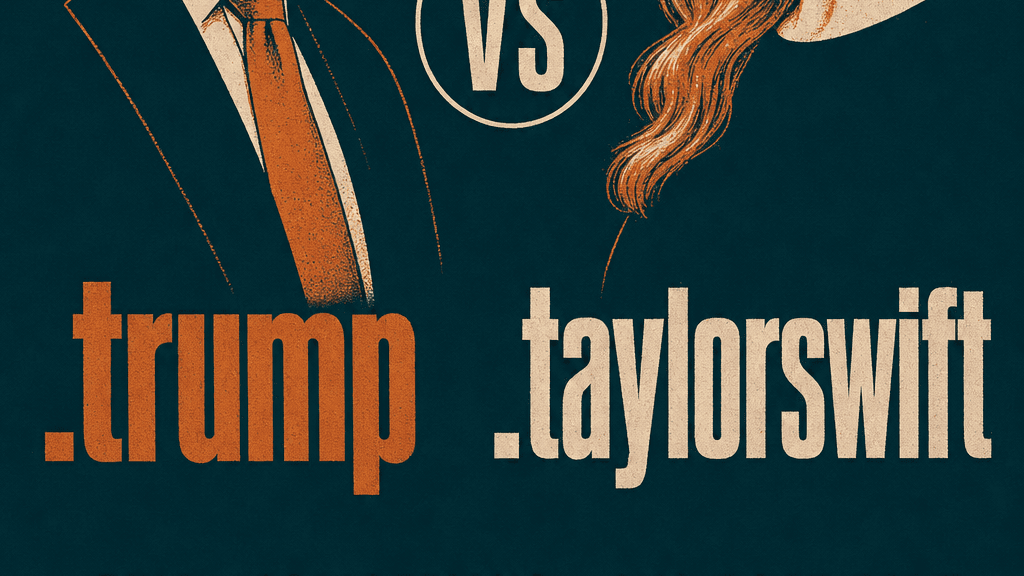
This piece reads two brand applications whose string is a person's name: .trump and .taylorswift. Each has a single applicant, no competitor and no replacement string. Other applications in the round are built on a name too; these two are the ones read here, not a count.
.trump
The applicant is DTTM TLD, LLC, a Delaware limited liability company. It declares DTTM Operations LLC as its parent Q26 and material shareholder Q106; no answer to the ultimate-control question is published Q108.
The string is defined this way:
TRUMP is a surname that has acquired distinctiveness and secondary meaning through decades of continuous, substantially exclusive commercial use. Owned by DTTM Operations LLC, it functions primarily as a source identifier. Q118
The mission is that of a closed brand registry: ".trump" is to serve "as a dedicated, trusted namespace for DTTM TLD LLC and its affiliates", and the "intended registrants of .trump are exclusively DTTM TLD LLC and its affiliates" Q133. On the generic-string question, the filing argues over several paragraphs Q184. One sentence of it:
"Trump" functions as a personal surname and, in this context, as the distinctive brand name associated with the Trump Organization and its affiliated business interests.
.taylorswift
The applicant is TAS Rights Management, LLC, a member-managed limited liability company in Tennessee. Material shareholder and ultimate control are declared as the same person: Taylor Alison Swift Q106 Q108.
The definition field holds three words: "No English Translation" Q118. The mission:
We intend to operate the .TAYLORSWIFT TLD as a dotBrand TLD where all domain registrations will be restricted to Affiliate organizations (as defined in the Registry Agreement) and, potentially, to licensees of our trademarks. Q133
And on the generic-string question, one sentence Q184:
We affirm that the applied-for string, TAYLORSWIFT, corresponds to a brand with multiple registered trademarks and thus is not a “Generic String” as defined in Specification 11, Section 3(d).
What the two have in common
Both rest on trademarks rather than on the name as such: a brand TLD requires a registered trademark, and each filing attaches a certificate Q181 that ICANN does not publish. Both are closed registries: nobody outside the applicant, its affiliates and, for one of them, its licensees could register a name. Neither offers voluntary commitments Q170 Q172.
They differ in what they say. One filing explains over several paragraphs why a surname is a brand; the other states it in a sentence and declares, as ultimate control, the person whose name is the string.
The 2012 precedent
A personal name at the top level is not new. In the 2012 round, .richardli was applied for by Pacific Century Asset Management (HK) Limited; ICANN's application status list for that round gives it as "Delegated". It is the one case of that list we cite here, and we have not searched the list for others: this is a precedent, not a count.
What this piece does not say
It does not say what either namespace will be used for beyond what the missions state, and it does not rank the two. A brand TLD is a registry for one organisation's own names; these two filings say that the organisation's brand happens to be a person's name.
Sources
- Published filings DTL2673T-T54519 and TRML2619T-T56523, ICANN APS, snapshot of 8 October 2026.
- ICANN Reveal Day export of 7 October 2026 (one application per string, no replacement string).
- ICANN 2012 round application status list (gtldresult.icann.org, read on 7 October 2026; copy in
data/icann-2012_applicationstatus.csv), entry RICHARDLI: application 1-1309-98748, status "Delegated".