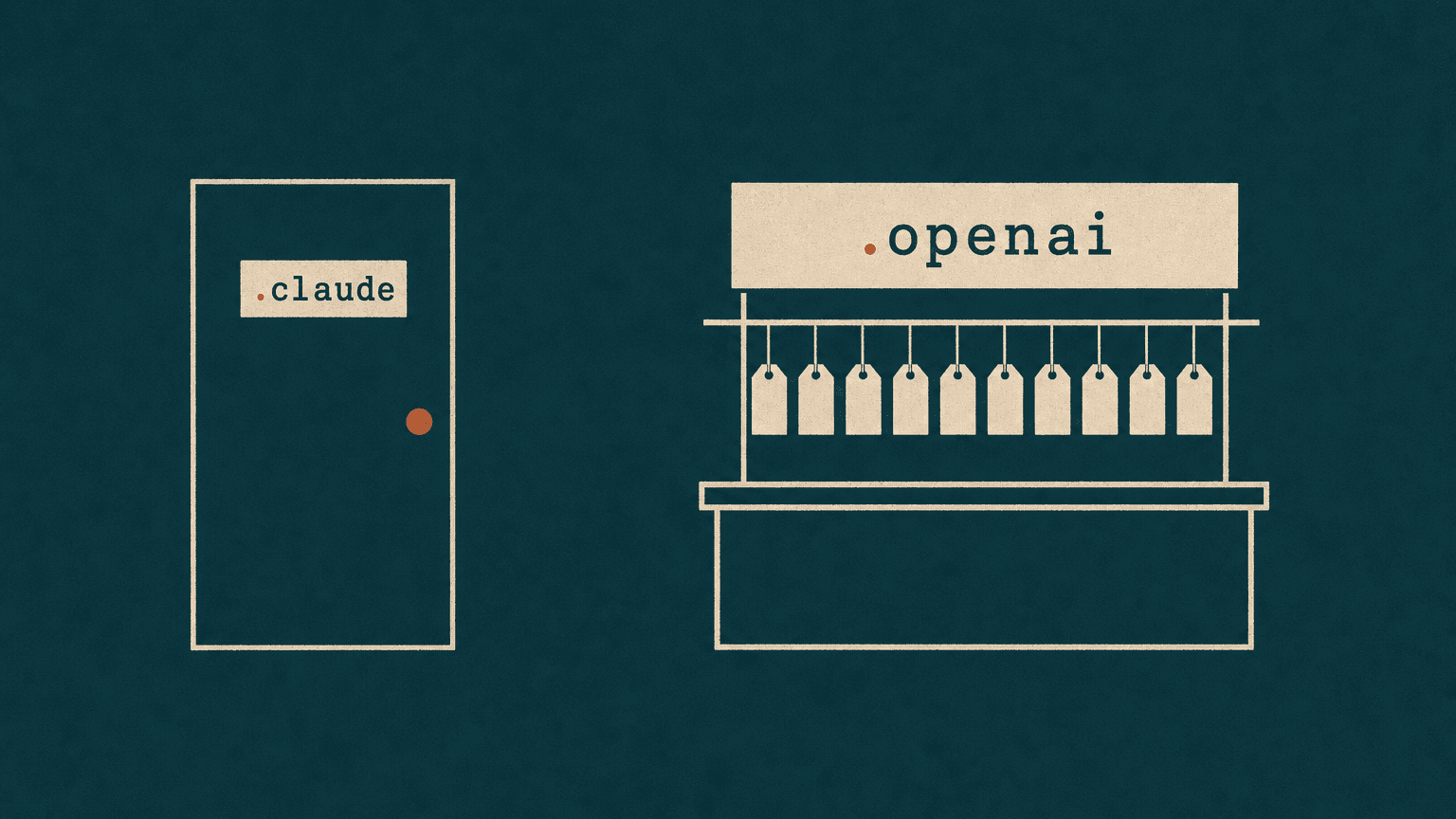
Anthropic files its two brands, and nothing else
Anthropic has two applications in the 2026 round, .claude and .anthropic. Both are brand TLDs, each backed by a certificate from the US trademark office attached to the application Q181: ANTHROPIC, registered on 3 September 2024, and CLAUDE, registered on 7 January 2025. No one else is applying for these two strings, and Anthropic has declared no replacement string.
The two applications say the same thing about who will be able to register a name Q133:
Names in .CLAUDE will be registered only by Anthropic, PBC, its affiliates, and partners it licenses to register under this gTLD.
The word "partners" comes back four times in that one answer. The extension is closed, but it is written to be shared with others, under licence, and the application gives the reason:
For us this is as much a safety matter as a branding one.
The argument is that if only Anthropic and its licensees register, a site in .claude necessarily comes from Anthropic "or a trusted partner", which closes one avenue for impersonation and phishing. The application announces addresses for its products, its documentation and its job offers, and specifies that the extension "doesn't depend on outside registrations to keep going": Anthropic funds it and does not plan to sell names in it.
Anthropic appears a third time in the round without being an applicant. The MCP protocol, which it created and then handed to a foundation in December 2025, has an extension applied for by five applicants, and it is Google that applies for it on behalf of the protocol's community. Anthropic attached a letter of support to that application, dated 7 August 2026. We read it for the piece on .mcp.
OpenAI also files ten words, open to all
OpenAI has fifteen applications. Five are brand TLDs: .openai, .chatgpt, .gpt, .codex and .oai. They describe "a controlled namespace" reserved for OpenAI and its affiliates, and the one for .openai speaks of a "closed, single-registrant" TLD Q133. The word "partner" does not appear in them.
The ten others are words: .agent, .agi, .asi, .daybreak, .deploy, .evals, .mcp, .model, .skill and .voice. All are declared open to anyone. Eight carry the same sentence, give or take one term Q133:
.agent will operate on an open registration model, available to any registrant without eligibility restrictions and without conditions tied to any particular company, industry, technology, or use.
The application then describes the work of a registry that sells names to the public. It plans a "[b]road registrar distribution to make .agent names widely available", and it states that OpenAI has the capacity "to run the registry over the long term".
I looked at what ICANN publishes as attachments for these fifteen applications. They contain OpenAI's self-certifications, three per application, and one trademark certificate for each of the five brands. No document comes from a third party. In the published answers, no other company is named: not Microsoft, not Google, not Anthropic, nor the foundation to which the MCP protocol was handed and of which OpenAI is nonetheless one of the founders, according to Anthropic's own announcement, which speaks of a fund "co-founded by Anthropic, Block and OpenAI" (announcement of 9 December 2025).
Nine of OpenAI's fifteen strings are contested
Neither of Anthropic's two strings has another applicant. At OpenAI, eight of the ten words do: .agent brings together thirteen applicants, .agi seven, .asi and .mcp five, .model, .skill and .voice three, .deploy two. Only .evals and .daybreak have OpenAI alone. One brand is contested too: .gpt, which OpenAI defines as "a coined term, created by OpenAI" Q118 and which two other applicants are applying for as a standard application.
On .mcp, the two companies find themselves on either side. OpenAI proposes the extension open to all, and the applicant Anthropic supports, Google, proposes an extension reserved for those who run the protocol, with the foundation's letters.
My reading
What holds my attention is that these two strategies are diametrically opposed. Anthropic makes only two brand filings, very defensive ones. It even leaves the protocol it invented: it is Google that applies for its extension, and Anthropic supports Google so that it can operate it. Anthropic had already donated the protocol to the community, notably to the Linux Foundation, so it is logical. I see in it no intention of selling domain names, only a use for brand protection.
OpenAI, for its part, goes as far as proposing open extensions, and so as far as becoming, in effect, a real open registry.
There is also at OpenAI an impression of being alone in the world, fifteen applications under a single name and nine strings to contest with others, where Anthropic builds many more partnerships.
To watch
- 17 November 2026: String Confirmation Day, then the opening of comments and objections until 16 March 2027. We will look at whether OpenAI or Anthropic comment on an application.
- Until 27 November 2026: withdrawal with a 65% refund. We will look at whether OpenAI keeps its nine contested strings.
Sources
- Anthropic's two applications and OpenAI's fifteen, ICANN APS, snapshot of 8 October 2026.
- The two trademark certificates attached by Anthropic to question 181, downloaded on 12 October 2026.
- The list of attachments published by ICANN for these seventeen applications, taken on 12 October 2026.
- Anthropic's letter attached to question 156 of Google's application for .mcp, dated 7 August 2026.
- Anthropic, announcement of 9 December 2025 on the donation of the MCP protocol to the Agentic AI Foundation.
OpenAI's attachments were recorded by their title and their question; the files were not opened. A standard application does not have to produce a letter of support: their absence from OpenAI's applications is an observation, not a clue. Company names were searched for in the published answers of the fifteen applications with the terms microsoft, google, anthropic, linux foundation and agentic ai foundation. OpenAI's partnerships outside the round were not looked at here. The answers of the two other applicants for .gpt have not been read; that will be the piece of 20 October.