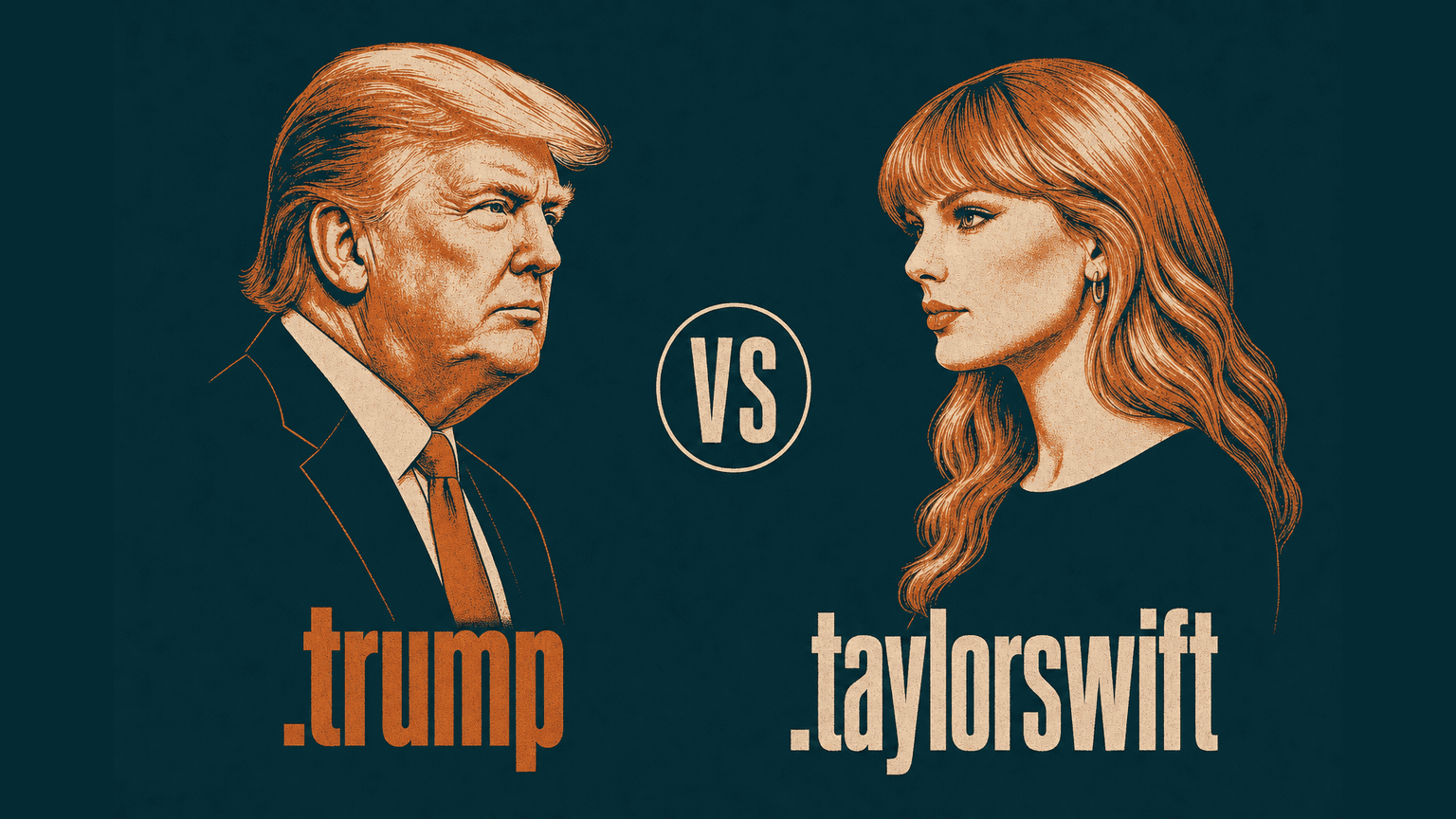
Two brand applications in the 2026 round have a person's name as their string: .trump and .taylorswift. Each has a single applicant, no competitor and no replacement string. Other applications in the round are built on a name too; these two are the ones read here, not a count.
.trump: a surname argued over several paragraphs
The applicant is DTTM TLD, LLC, a Delaware limited liability company. It declares DTTM Operations LLC as its parent Q26 and material shareholder Q106; no answer to the ultimate-control question is published Q108.
The string is defined this way:
TRUMP is a surname that has acquired distinctiveness and secondary meaning through decades of continuous, substantially exclusive commercial use. Owned by DTTM Operations LLC, it functions primarily as a source identifier. Q118
The mission is that of a closed brand registry: .trump is to serve "as a dedicated, trusted namespace for DTTM TLD LLC and its affiliates", and the "intended registrants of .trump are exclusively DTTM TLD LLC and its affiliates" Q133. On the generic-string question, the filing argues over several paragraphs Q184. One sentence of it:
"Trump" functions as a personal surname and, in this context, as the distinctive brand name associated with the Trump Organization and its affiliated business interests.
.taylorswift: one sentence, and the person as ultimate control
The applicant is TAS Rights Management, LLC, a member-managed limited liability company in Tennessee. Material shareholder and ultimate control are declared as the same person: Taylor Alison Swift Q106 Q108.
The definition field holds three words: "No English Translation" Q118. The mission:
We intend to operate the .TAYLORSWIFT TLD as a dotBrand TLD where all domain registrations will be restricted to Affiliate organizations (as defined in the Registry Agreement) and, potentially, to licensees of our trademarks. Q133
And on the generic-string question, one sentence Q184:
We affirm that the applied-for string, TAYLORSWIFT, corresponds to a brand with multiple registered trademarks and thus is not a “Generic String” as defined in Specification 11, Section 3(d).
Two closed registries, each resting on a trademark
Both filings rest on trademarks rather than on the name as such: a brand TLD requires a registered trademark, and each filing attaches a certificate Q181 that ICANN publishes separately, under the filing's Documents tab. Both are closed registries: no one outside the applicant, its affiliates and, for .taylorswift, its licensees could register a name there. Neither offers voluntary commitments Q170 Q172.
They differ in what they say. One filing argues over several paragraphs why a surname is a trademark; the other asserts it in one sentence and declares, as ultimate control, the person whose name is the string.
The Guidebook asks for a trademark that carries exactly the string
The mechanism is the .Brand TLD Eligibility Evaluation. Its first criterion: "The applied-for gTLD string must exactly match the textual elements of a registered trademark verified by the TMCH in the provided SMD files" (section 7.3.3.2). The Guidebook adds that "the applicant must confirm non-generic usage in its application": that is what question 184 is for. If the evaluation fails, the application does not stop there: "the applicant may elect to continue with its application without the .Brand TLD designation" (section 7.3.3.4).
The .trump filing argues on the distinctiveness of the name; the Guidebook's criterion bears on the registered trademark. For both strings, the question is whether the attached certificate carries exactly the string. We have not yet read these two certificates.
.richardli, applied for in 2012 and delegated
A personal name at the top level is not new. In the 2012 round, .richardli was applied for by Pacific Century Asset Management (HK) Limited; ICANN's application status list for that round gives it as "Delegated". It is the one case of that list we cite here, and we have not searched the list for others: this is a precedent, not a count.
To watch
- 17 November 2026: String Confirmation Day; the Community Input and Objections Period opens the same day and runs until 16 March 2027.
- The result of the .Brand evaluation will be published with the evaluation reports (section 7.3.3.4). ICANN has not yet announced when application evaluation starts.
What this piece does not say
It does not say what either namespace will be used for beyond what the missions state, or whether the .Brand evaluation will succeed, and it does not rank the two. A brand TLD is a registry for one organisation's own names; these two filings say that the organisation's brand happens to be a person's name.
Sources
- Published filings DTL2673T-T54519 and TRML2619T-T56523, ICANN APS, snapshot of 8 October 2026.
- ICANN Reveal Day export of 7 October 2026 (one application per string, no replacement string).
- ICANN, Applicant Guidebook for the 2026 round, version of 16 December 2025 (sections 7.3.3.2 and 7.3.3.4); announcement of 29 September 2026 on the steps of the round.
- ICANN 2012 round application status list (gtldresult.icann.org, read on 7 October 2026; copy in
data/icann-2012_applicationstatus.csv), entry RICHARDLI: application 1-1309-98748, status "Delegated".